
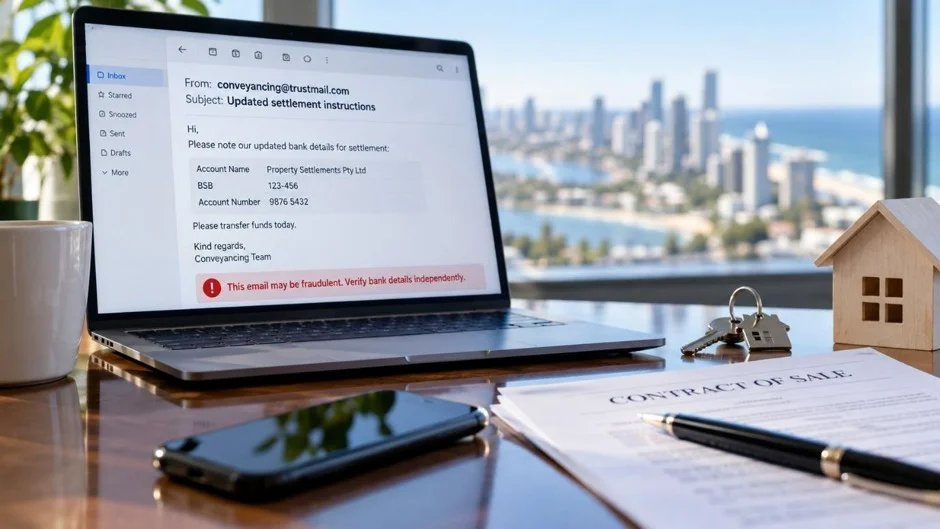
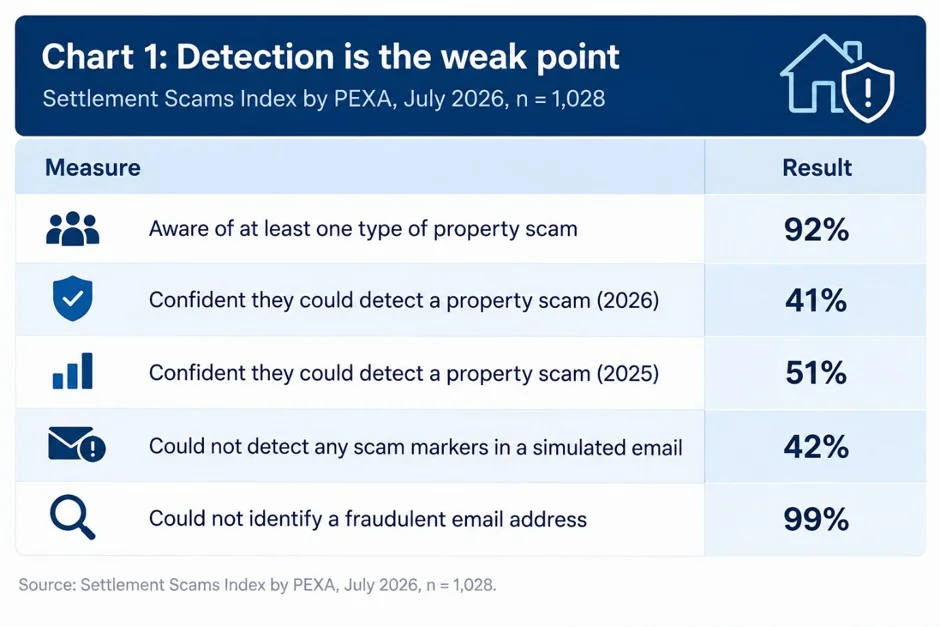
Property settlement scams are becoming harder to spot as criminals use increasingly sophisticated technology to impersonate trusted people involved in a transaction. PEXA’s latest Settlement Scams Index found 92% of respondents were aware of at least one type of property scam, yet confidence in being able to detect one fell to 41%, down from 51% a year earlier.
With large sums changing hands during Gold Coast property transactions, falling for a convincing scam can be financially devastating. It also raises a complicated question. If the money reaches a scammer instead of the intended recipient, who ultimately bears the loss?
How do property settlement scams work?
According to the PEXA report, business email compromise remains the biggest threat during settlement. A criminal may access an email account or imitate a real estate agent, conveyancing lawyer or another property professional involved in the transaction, then send altered bank details at the moment funds are expected.
PEXA also identifies AI-enabled voice cloning as an emerging threat, with 62% of respondents concerned about its use, potentially making impersonation attempts even more convincing.
The research, conducted in July 2026 among 1,028 Australians who had recently bought or intended to buy property, tested detection skills directly.
The National Anti-Scam Centre reported combined losses of $166.8 million from payment redirection scams across Australia in 2025, up from $152.6 million in 2024, second only to investment scams.
Who bears the loss when settlement funds are misdirected?
There is no rule that automatically makes the buyer, seller, Gold Coast property lawyer, conveyancer or bank responsible. The answer may depend on the contractual payment obligation, where the fraudulent instructions originated, and whether another party owed and breached a relevant duty.
A Queensland decision illustrates the starting point. In Factory Direct Fencing Pty Ltd v Kong AH International Company Ltd [2013] QDC 239, a fraudster interfered with email communications between a buyer and a supplier, and the buyer transferred payment to the fraudster. The District Court declined to impose the duty of care alleged against the supplier.
The buyer had also been alerted to a problem when its bank advised that the beneficiary details did not match the account number, but proceeded without confirming the changed details with the supplier by telephone or another non-email method.
That was a commercial supply matter rather than a residential settlement, but it shows why transferring money does not necessarily mean a payment obligation has been met.
What if the hacked account belonged to the other party?
Mobius Group Pty Ltd v Inoteq Pty Ltd [2024] WADC 114 shows the same problem reaching an Australian court more recently. A third party accessed the genuine email account of contractor Mobius and sent changed bank details to Inoteq, which owed Mobius money.
Inoteq attempted to verify the change by telephone, but its employee could not hear Mobius’s response because of the poor connection. Rather than making another call, Inoteq then sought confirmation by email through the very account that had been compromised, and made the payment.
The District Court of Western Australia found in favour of Mobius and ordered Inoteq to pay $191,859.16 plus interest. In reaching its decision, the court considered that Inoteq was in the better position to protect itself from the fraud, including by making another telephone call to verify the changed account details.
A Western Australian decision does not bind a Queensland court, but it provides another Australian example of a payer remaining liable after transferring money in reliance on fraudulent payment instructions.
Could a conveyancing lawyer be liable?
A different question arises where the conduct of a solicitor contributed to the loss. Queensland’s electronic conveyancing operates under the Electronic Conveyancing National Law (Queensland), and solicitors also owe professional and fiduciary duties to clients.
Whether conveyancing solicitors on the Gold Coast could be liable would depend on their role, the instructions received, what happened when payment details were provided or changed and the particular legal duties that applied.
Neither of the cases above involved a solicitor, and in each the loss stayed with the party that made the payment. A claim against a conveyancing lawyer would therefore turn on something more than the fact that a scam occurred during a transaction they were handling.
Will a bank refund money lost in a property scam?
A bank is not automatically required to reimburse a customer who authorised a payment to a scammer. However, whether a bank bears some responsibility can depend on the circumstances, including the warning signs available to it and the steps it took before and after the payment.
Banks have rolled out Confirmation of Payee under the Scam-Safe Accord, which checks whether the account name entered matches the details held by the recipient bank.
AFCA’s jurisdiction over scam complaints involving receiving banks expanded on 12 March 2026, meaning consumers and eligible small businesses may now be able to complain about both the bank sending the funds and the bank that received them. Complaints generally need to be raised with the relevant bank first before going to AFCA.
Most obligations under Australia’s Scams Prevention Framework commence on 31 March 2027. Designated organisations have already been required to be AFCA members since 1 September 2026, while AFCA’s broader SPF complaints jurisdiction will commence from 31 March 2027.
How can Gold Coast property buyers reduce the risk?
PEXA found 84% of respondents said they would verify new payment instructions with a real, known person, face to face or by telephone. That verification needs to be independent. Obtain trust account details from your conveyancing lawyer at the outset using a number you sourced yourself, treat any change to payment instructions as suspect, and take Confirmation of Payee warnings seriously.
Who ends up bearing the loss?
Liability after a property settlement scam is rarely a single clean answer. The Australian cases discussed above show that the steps taken by the paying party to verify changed bank details can be important, which means transferring funds to a criminal may not discharge the original payment obligation.
Questions about whether a professional or bank may also bear responsibility will depend on their particular obligations and conduct in the circumstances, established from contracts, payment instructions, emails and phone records.
If you have lost money through a property scam or are involved in a dispute over misdirected settlement funds, our property lawyers on the Gold Coast can review the transaction, payment instructions and relevant communications, and advise on your legal position and potential recovery options. Contact our team to arrange a confidential discussion about your matter.
Frequently Asked Questions
There is no single answer that applies to every scam. The contract, payment instructions, circumstances of the fraud and conduct of the parties can all be relevant. Australian cases have shown that paying money to a scammer may not discharge an obligation to pay the intended recipient.
Potentially, depending on the circumstances. Liability is not automatic simply because a solicitor or conveyancer was involved. A Gold Coast property lawyer can review how the loss occurred and whether another party may have breached a relevant legal duty.
Not automatically. The outcome can depend on how the payment occurred and the bank’s obligations in the circumstances, and an unresolved complaint can go to AFCA where it has jurisdiction. Contact the bank immediately if you discover a fraudulent transfer.
Do not verify the change by replying to the same email, which is what went wrong in Mobius. Contact your conveyancing lawyer or the intended recipient independently, using contact details you already know to be genuine, and confirm the instructions before transferring anything.
Contact your bank immediately and preserve all emails, payment records, messages and other communications connected with the transaction. Obtaining prompt advice from a property litigation lawyer may also help establish whether the original payment remains owing and whether there are avenues for recovering the loss.