

Property disputes on the Gold Coast rarely begin in a courtroom. Most start with a fence in the wrong place, a contract that falls over before settlement or a caveat that appears on a title without warning.
A property litigation lawyer can help you understand your rights, the deadlines that apply and which court or tribunal may hear the dispute.
Boundary disputes between Gold Coast neighbours
Boundary disputes can arise when neighbours disagree about the location of a property boundary or the use of land along it. Common causes include dividing fences, retaining walls and buildings that extend onto neighbouring properties. The appropriate way to resolve a dispute depends on its nature and the rights involved.
Can a landlord refuse consent to a commercial lease assignment?
Dividing fences and the notice to contribute
Fence disputes in Queensland fall under the Neighbourhood Disputes (Dividing Fences and Trees) Act 2011. According to QCAT’s dividing fence guidance, disputes about proposed fencing work generally require a notice to contribute before an application can be made to QCAT. If no agreement is reached within one month, either neighbour may generally apply to QCAT within two months of giving the notice.
QCAT generally hears these disputes up to $25,000, with different rules for pool barrier fences, and its Form 53 application excludes retaining walls. According to QCAT’s 2024–25 annual report, Gold Coast owners can lodge applications through the Southport registry. Property lawyers on the Gold Coast can help ensure the notice meets statutory requirements.
When a building crosses the boundary
In Wardanski v Mawby, the Supreme Court of Queensland confirmed that an unauthorised structure extending onto a neighbour’s land is a trespass at common law, which may lead to a claim for compensation or a court order requiring its removal.
Since 1 August 2025, sections 183 to 186 of the Property Law Act 2023 (Qld) have provided a framework for court orders about encroaching buildings, including minimum compensation where the court orders payment.
Business Queensland recommends engaging a registered cadastral surveyor to carry out an identification survey. Property lawyers on the Gold Coast will often ask for one before any demand is made.
Contract disputes under the Property Law Act 2023
Under section 7 of the Property Law Act 2023, a contract for the disposition of land is generally not enforceable unless the contract, or a written note or memorandum of it, is signed by the party against whom enforcement is sought. Experienced conveyancing solicitors on the Gold Coast can help ensure every agreed term is captured in the contract itself.
Seller disclosure and termination rights
Section 99 requires a seller to give the buyer a disclosure statement and each prescribed certificate before the buyer signs. Under section 104, a buyer may be entitled to terminate before settlement if those documents were not provided, subject to statutory exceptions.
Where disclosure was inaccurate or incomplete, the Queensland Government says the buyer must show the issue was material, that they were unaware of it when signing and that they would not have signed had they known.
Having conveyancing solicitors on the Gold Coast check disclosure documents before signing can reduce the risk of a dispute. QBM’s areas of practice cover both conveyancing and property law.
Remedies for property contract breaches
Depending on the circumstances, remedies may include damages, termination where permitted or specific performance, an order requiring a party to complete the contract. A property litigation lawyer can assess whether a breach has occurred, whether termination was valid and whether the deposit is recoverable.
How a Gold Coast caveat lawyer approaches caveat disputes
Titles Queensland explains that a person claiming an interest in land can lodge a caveat under sections 121 to 131 of the Land Title Act 1994, but only where the courts recognise the interest as capable of supporting a caveat.
Being owed money is not enough on its own. As illustrated in Circuit Finance Australia Ltd v Registrar of Titles, a lender whose agreement charges the land as security may qualify. Registration does not prove the interest exists.
Under section 126, an affected owner can serve a notice requiring the caveator to start court proceedings to establish their interest, and must notify the registrar within 14 days of serving it.
If the owner complies with that requirement, the caveator has 14 days from service of the notice to start proceedings and notify the registrar, or the caveat lapses. Without a notice, the caveator has three months from lodgement to take those steps.
These rules do not apply to every caveat, such as one lodged with the registered owner’s consent. Owners can also apply to the Supreme Court for removal under section 127 of the Land Title Act 1994 (Qld)
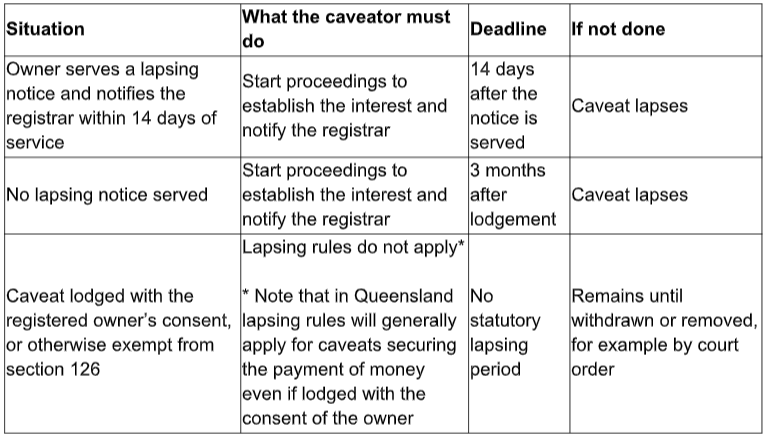
Source: Land Title Act 1994 (Qld) s 126, as set out in Circuit Finance Australia Ltd v Registrar of Titles [2005] QSC 283.
The 14-day and 3-month periods indicated above have different triggers and apply only to lapsing caveats.
Under section 130 of the Land Title Act 1994, a person who lodges or continues a caveat without reasonable cause must compensate anyone who suffers loss or damage as a result A Gold Coast caveat lawyer can assess whether an interest is caveatable before anything is lodged, or act quickly to challenge a caveat holding up a sale.
Where Gold Coast property disputes are heard
The Queensland Courts website provides information about the jurisdiction of Queensland’s courts, while QCAT explains the types of disputes it can hear.
Queensland courts and tribunals – general monetary claim limits
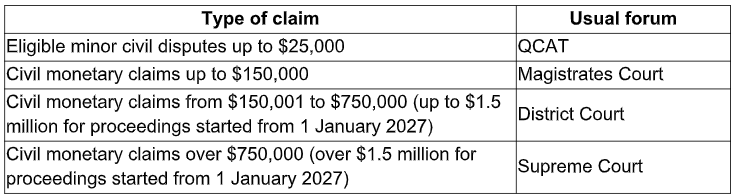
These limits above generally apply to monetary claims. The appropriate court or tribunal also depends on the type of dispute and the orders sought. The District Court’s limit increases under the Justice and Other Legislation Amendment Act 2026.
Claims seeking remedies such as declarations, specific performance or injunctions may need to be brought in the District or Supreme Court, depending on the circumstances. Filing in the wrong court or registry may mean a costly transfer, so a civil litigation lawyer can confirm the correct forum first.
Many disputes can be resolved through negotiation or mediation, with litigation lawyers helping to prepare evidence and negotiate an agreement. A civil litigation lawyer can also advise whether the likely outcome justifies the cost of proceeding.
Protecting your property interests on the Gold Coast
Boundary, contract and caveat disputes can involve different legal procedures, deadlines and remedies. Understanding which rules apply can help property owners and buyers avoid unnecessary delays and costs.
Early advice from litigation lawyers may help you protect your position, limit costs and choose the right forum if a dispute cannot be settled.
If you are facing a boundary, contract or caveat dispute on the Gold Coast, QBM Lawyers can review your documents, explain your position under Queensland law and assist with negotiation, tribunal proceedings or court action where required. Whether you need a Gold Coast caveat lawyer to act quickly on a title or a property litigation lawyer to resolve a broader dispute, contact our team to arrange a confidential discussion about your matter.
Frequently Asked Questions
Not every caveat lapses automatically. A lapsing caveat generally ends three months after lodgement unless the caveator starts proceedings and notifies the registrar. If the owner serves a notice under section 126 of the Land Title Act 1994 and complies with the registrar notification requirement, the caveator has 14 days after service to take those steps. Some caveats lodged with the registered owner’s consent, among others, are exempt from these lapsing rules, however this does not apply to caveats securing the payment of money.
Yes, in some circumstances. A person with an interest the courts recognise as caveatable may lodge a caveat without the owner’s consent. However, anyone who lodges or continues a caveat without reasonable cause may have to pay compensation for the loss it causes.
Business Queensland recommends engaging a registered cadastral surveyor to carry out an identification survey. The survey can show whether a fence or structure sits on the common boundary before you raise the issue with your neighbour.