


Commercial disputes can disrupt business operations, strain professional relationships and create financial uncertainty. The Gold Coast had more than 83,000 actively trading businesses at 30 June 2025, according to the Australian Bureau of Statistics, and
disagreements over unpaid invoices, breached contracts and business partnerships are a regular part of commercial life.
Not every commercial dispute needs to end up in court, and many can be resolved through negotiation or mediation. However, delaying legal advice may weaken your position, increase costs or leave you with fewer options. Business Queensland notes there is no Queensland government agency offering alternative dispute resolution for business-to-business contract disputes. understanding when to engage lawyers for litigation can help Gold Coast business owners protect their interests and make informed decisions.
What is commercial litigation?
Commercial litigation is the legal process used to resolve disputes arising from business and commercial relationships. It generally involves civil rather than criminal law.
Common commercial disputes include:
- Breach of contract: One party fails to fulfil its contractual obligations.
- Unpaid debts: A customer or another business refuses or fails to pay money owed.
- Partnership and shareholder disputes: Business owners disagree over management, finances or their respective rights.
- Commercial lease disputes: Landlords and tenants disagree over rent, repairs or lease terms.
- Misleading or deceptive conduct: A business alleges another party has breached the Australian Consumer Law, which forms Schedule 2 of the Competition and Consumer Act 2010 (Cth).
Many of these disputes involve Queensland law, such as the Property Law Act 2023 (Qld) and the Retail Shop Leases Act 1994 (Qld). Commonwealth legislation, contract terms and the particular circumstances can also affect which laws apply, and company insolvency issues may require input from an insolvency lawyer. A commercial lawyer can review the relevant agreements and explain which laws are likely to apply.
When should you engage a civil litigation lawyer?
1. You have received a statutory demand or court documents
Under rule 137 of the Uniform Civil Procedure Rules 1999 (Qld), a defendant generally has 28 days after being served with a claim to file a notice of intention to defend. Exceptions can apply. Missing the deadline can expose your business to default judgment.
A company served with a statutory demand under the Corporations Act 2001 (Cth) generally has 21 days from service to comply, by paying, securing or compounding the debt to the creditor’s satisfaction, or to apply to the court to have the demand set aside. If the company does neither, it fails to comply with the demand, and a court can presume it insolvent in a winding-up application brought within the following three months. An insolvency lawyer can advise whether grounds exist to challenge the demand, such as a genuine dispute about the debt or an offsetting claim.
2. A contract has been breached
A breach may occur when a supplier fails to deliver agreed goods, a contractor does not complete work or a business fails to make a required payment. A civil litigation lawyer can review the contract, determine whether a breach has occurred and identify potential remedies. Depending on the circumstances, these may include damages, termination or an order requiring a party to perform its obligations.
3. Your business is owed a substantial debt
QCAT can hear minor debt claims for fixed amounts of up to $25,000 (excluding interest), and parties generally represent themselves. Not every claim under $25,000 qualifies, however. Larger claims move into the court system, where formal pleadings, disclosure obligations and costs risks apply.
Table: Where Queensland money disputes are usually heard
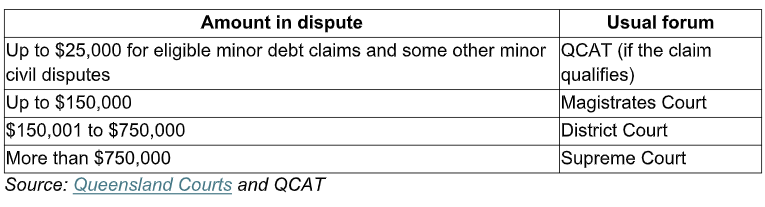
The Southport courthouse is home to the Gold Coast’s Magistrates Court, and Queensland Courts publishes a combined Supreme and District Courts law list for Southport. Debt recovery lawyers can prepare a formal letter of demand and advise on the prospects of recovery.
4. A dispute threatens your business operations
A shareholder dispute may prevent important business decisions, while a disagreement over commercial premises could threaten a company’s ability to keep trading. A commercial lawyer on the Gold Coast can consider whether urgent action is appropriate, which may include seeking an injunction to prevent certain conduct or preserve the position until the dispute is resolved.
5. Negotiations or mediation have stalled
The Queensland Small Business Commissioner (QSBC), whose mediation service covers eligible retail and small business lease disputes, helped parties reach agreement in 68% of disputes in 2025–26, closing disputes in an average of 40 days, according to its annual report. The QSBC states it cannot assist with business-to-business disputes, which generally rely on negotiation, private mediation or the courts. Figures tabled in Queensland Parliament show disputes lodged with the QSBC rose from 115 in October–December 2024 to 157 in July–September 2025.
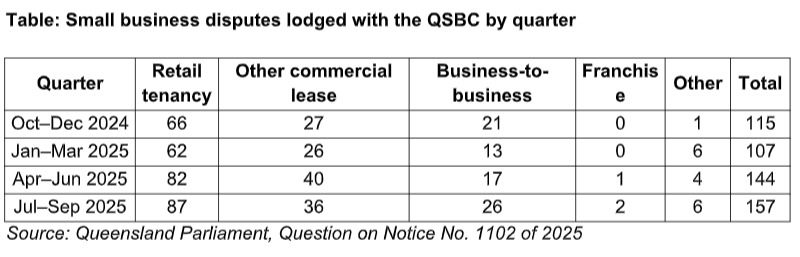
The figures represent disputes lodged with the QSBC, not necessarily disputes accepted for mediation or resolved through its services.
Engaging lawyers for litigation does not necessarily mean starting court proceedings, as a lawyer may help by clarifying the legal issues, negotiating a settlement or arranging mediation.
What should you consider before starting commercial litigation?
Important considerations before commencing proceedings include:
- Evidence: Are there contracts, invoices, emails and other records supporting your claim?
- Costs: Could legal expenses outweigh the potential recovery, and what is your exposure to an adverse costs order?
- Time: How might proceedings affect your business operations?
- Enforcement: Would the other party be able to satisfy a judgment?
- Limitation periods: Is there a deadline for commencing legal action?
Experienced Gold Coast business lawyers can help you weigh these factors.
Under section 10 of the Limitation of Actions Act 1974 (Qld), most claims for breach of a simple contract must be commenced within six years of the cause of action arising.
Amendments made by the Property Law Act 2023 (Qld) also cut the limitation period for an action on a deed from 12 years to six years. Under section 51 of the Limitation of Actions Act, the shorter period applies only to deeds made after the new Act commenced on 1 August 2025, so earlier deeds generally keep the 12-year period. Other periods can apply to some claims.
Once proceedings begin, rule 5 of the Uniform Civil Procedure Rules requires courts to apply the rules with the aim of avoiding undue delay, expense and technicality, and parties impliedly undertake to proceed in an expeditious way. If a party does not comply with the rules or a court order, the court may impose appropriate sanctions, which can include costs consequences. A civil litigation lawyer can help you meet these obligations, while debt recovery lawyers can pursue enforcement if a judgment remains unpaid.
Get legal advice before a commercial dispute escalates
Court documents, statutory demands, breached contracts, unpaid debts and stalled negotiations are all signs it may be time to seek advice. Engaging a commercial lawyer early can help you assess the dispute and identify suitable resolution options, while Gold Coast business lawyers can guide you from negotiation through to court if required.
If your Gold Coast business is involved in a commercial dispute, QBM Lawyers can review relevant agreements, explain your position under Queensland law and assist with negotiation, mediation or court proceedings where required. Speak with acommercial lawyer on the Gold Coast or one of our lawyers for litigation about your circumstances. Contact our team to arrange a confidential discussion about your matter.
Frequently Asked Questions
Commercial legal advice generally focuses on contracts, transactions and business obligations, while litigation focuses on resolving disputes through negotiation, mediation and court proceedings. The two areas often overlap in commercial disputes, so many businesses benefit from advice that covers both.
Costs depend on the complexity of the dispute, the amount of evidence involved, the court in which proceedings are commenced and whether the parties reach an early settlement. A lawyer can explain likely legal fees, court costs and potential adverse costs orders before proceedings begin.
The timeframe varies depending on the complexity of the dispute, the court’s timetable and the parties’ willingness to negotiate. Some disputes settle within weeks or months, while contested court proceedings may take considerably longer.