

A recent Brisbane apartment development has highlighted the risks that can arise when off-the-plan contracts include termination clauses.
At Kokoda Property Group’s 144-apartment Ruby Ruby tower in Milton, buyers were informed their contracts had been terminated after the developer concluded the project could not proceed at the originally agreed prices. Construction costs had escalated to the point where additional revenue was required for the development to satisfy funding conditions.
Buyers were offered the option of receiving their deposits back or purchasing their apartments again at revised prices, in some cases more than $1 million higher than the original contract price. The situation has prompted renewed discussion about contractual provisions that allow developers to cancel agreements when projects become financially unviable.
Clauses allowing this outcome are commonly included in off-the-plan property contracts across Queensland. Known as sunset clauses or similar termination provisions, they set deadlines or conditions for a project to proceed and determine what happens if those conditions are not met.
Understanding how these clauses work is important before signing a contract. While sunset clauses can protect buyers from long delays, they may also allow a developer to terminate the agreement in certain circumstances. Queensland has introduced legal reforms in recent years to strengthen buyer protections, but the details of each contract still matter. Buyers often seek advice from property lawyers or a conveyancing lawyer before committing to an off-the-plan purchase.
What is a sunset clause in a property contract?
A sunset clause is a contractual provision that sets a deadline by which the development must be completed and the title registered so settlement can occur. If that deadline is not met, the clause may allow one or both parties to terminate the contract. These provisions are commonly reviewed during the property conveyancing process handled by experienced property lawyers.
Sunset clauses commonly appear in:
- off-the-plan land contracts
- house-and-land packages
- community title developments such as apartment buildings.
Construction delays, labour shortages, or supply chain disruptions can push projects beyond their original timelines. The sunset clause provides a contractual mechanism for dealing with those delays. Buyers on the coast often ask a Gold Coast solicitor or a Gold Coast property lawyer to explain how these timelines may affect settlement.
Can a developer cancel your contract in Queensland?
Queensland law places limits on when developers can rely on sunset clauses to terminate certain contracts.
Reforms introduced on 22 November 2023 amended the Land Sales Act 1984 (Qld) to restrict when sellers can terminate certain off-the-plan land contracts using sunset clauses. Under these reforms, a seller can only rely on a sunset clause in the following situations:
- the buyer provides written consent
- the Supreme Court of Queensland orders termination
- another circumstance prescribed by regulation applies.
These reforms apply to certain off-the-plan land contracts that were signed, or still ongoing, on or after 22 November 2023.
The changes were designed to prevent developers from cancelling contracts simply because market prices have increased since the original sale. However, the protections do not apply to every type of property transaction.
Queensland’s sunset clause reforms are also being reviewed to assess whether they are working as intended. In 2025, the Queensland Government invited feedback from consumers, developers and industry participants about the effectiveness of the 2023 legislative changes.
Where the reforms may not apply
Current Queensland reforms apply to many – although not all – regulated off-the-plan contracts. Depending on how a development is structured, certain arrangements may fall outside the regime.
Legal commentary from the Queensland Law Society has noted that apartment projects can still present risks for buyers where sunset clauses are used to terminate contracts. In more complex disputes, a property litigation lawyer may become involved.
This distinction can be particularly relevant on the Gold Coast, where many buyers purchase apartments off the plan within large developments.
Where the sunset date sits in an off-the-plan contract
The following simplified timeline illustrates how sunset clauses often operate in Queensland property contracts.
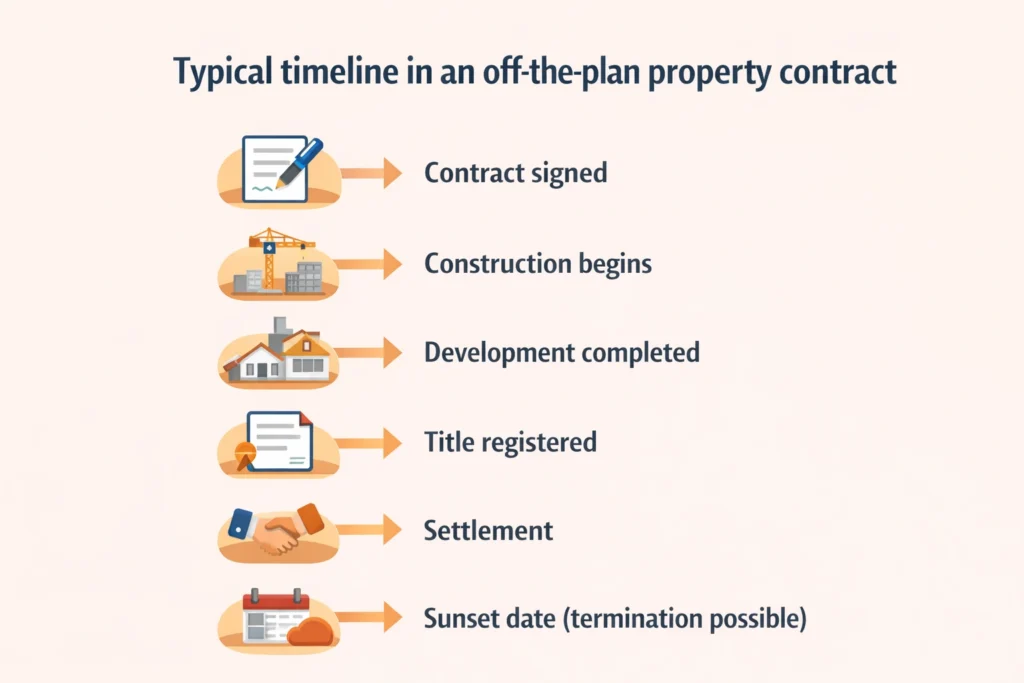
If the development has not reached settlement by the sunset date set out in the contract, the clause may allow either party to terminate the agreement depending on its wording. Buyers frequently ask a Gold Coast property lawyer or property lawyers on the Gold Coast to review these clauses before the deadline approaches.
Buyer protections under Queensland law
Queensland legislation provides several safeguards for buyers in off-the-plan transactions.
Disclosure requirements
Developers must provide a disclosure statement identifying the proposed property and development works involved. This includes information such as:
- the proposed lot number
- the total land area
- the orientation of the lot
- the expected state of the property when ownership transfers.
Reviewing these documents is typically part of the property conveyancing process undertaken by conveyancing solicitors on the Gold Coast.
Protection against major changes
If the developer changes key details in the disclosure statement, buyers may have the right to terminate the contract if the change causes material prejudice.
Material prejudice may include situations where:
- the size of the lot is significantly reduced
- major design changes alter the value or usability of the property.
Buyers must generally terminate within a very limited period after receiving notice of the change, or before settlement occurs, whichever happens first. Advice from property lawyers on the Gold Coast can assist in assessing whether material prejudice has occurred.
Limits on deposit access
Deposits paid under off-the-plan contracts must usually remain in a trust account until settlement occurs or the contract lawfully ends. This protects buyers if the contract is terminated.
Why sunset clauses sometimes cause disputes
The Ruby Ruby development illustrates how termination clauses can become controversial when market conditions change.
Construction cost escalation has affected many development projects across Australia in recent years, with shortages of materials, contractors and labour contributing to rising costs. In some cases, developers may rely on contractual provisions to terminate projects if financing conditions or construction feasibility cannot be met.
Court cases have also demonstrated the financial stakes involved in these disputes. In a Queensland Supreme Court decision in June 2025, a developer was ordered to repay approximately $6.1 million to a buyer after terminating off-the-plan contracts and later reselling the properties for $10 million.
How buyers on the Gold Coast can reduce risk
Buying off the plan can offer advantages such as securing a property early in a growing market, but it can also be fertile ground for dispute and disappointment. This can be particularly true where the market falls during the long contract period before the building is finished, such that the property is worth less than the contract price, or where a buyer is ‘locked in’ to a contract for years and misses other opportunities, only to find the contract terminated before settlement. Understanding the contract terms is essential.
Steps that may help reduce risk include:
- reviewing the sunset clause carefully
- checking who has the right to terminate the contract
- confirming whether the clause applies to the buyer, the developer or both
- seeking legal advice before signing the contract
- monitoring construction progress during the development.
Many buyers choose to speak with conveyancing solicitors on the Gold Coast or experienced property lawyers before committing to an off-the-plan purchase.
Why understanding sunset clauses matters for Gold Coast buyers
Sunset clauses are a standard feature in many off-the-plan property contracts across Queensland, establishing a deadline for development completion and settlement. However, while they can protect buyers from excessive delays, they may also operate to the detriment of the buyer in a rising market
Recent reforms have strengthened protections in off-the-plan land contracts by limiting when developers can terminate a contract using a sunset clause. However, the rules can differ depending on the type of development, and some property transactions may still allow broader termination rights.
Carefully reviewing the contract and understanding the legal implications of a sunset clause can help buyers avoid unexpected outcomes when purchasing property on the Gold Coast.
Understanding the fine print in an off-the-plan contract can make a significant difference to the outcome of a property purchase. If you are considering buying property on the Gold Coast and want advice about sunset clauses or other contract terms, contact QBM Lawyers to discuss your situation and understand your legal options before signing.
Frequently Asked Questions
A sunset clause sets a deadline for a development to be completed and settlement to occur. If the deadline is not met, the clause may allow one or both parties to terminate the contract depending on its wording.
In many off-the-plan land contracts, developers can only terminate the contract using a sunset clause if the buyer agrees in writing, the Supreme Court orders termination or another legal circumstance applies. However, these rules generally apply to standard land developments and may not apply to community title schemes or certain other types of developments.
Generally, developers do not have to obtain consent of buyers or orders from the Supreme Court to trigger termination under sunset clauses in unit developments.
Deposits paid under off-the-plan contracts are typically held in trust and refunded if the contract is lawfully terminated.
Legal advice is strongly recommended before signing any property contract. A lawyer can review the sunset clause, explain the risks and help you understand your rights if the development is delayed or the contract is terminated.
